Punjab Newsline | Tel Aviv
A recent Iranian missile strike in the Strait of Hormuz has claimed the life of an Indian crew member and injured eight people, including six other Indians, as tensions in West Asia continue to escalate.
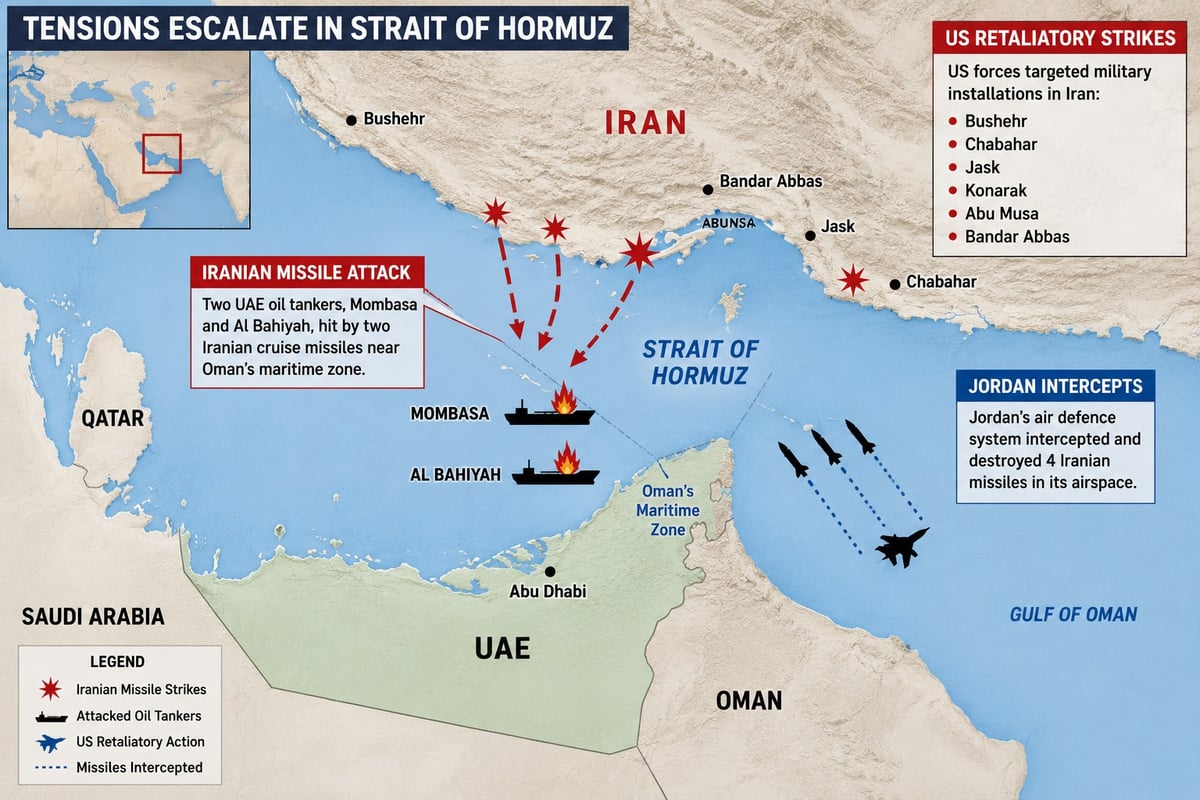
According to the UAE Ministry of Defence, two UAE oil tankers—Mombasa and Al Bahiyah—were struck by two Iranian cruise missiles while transiting near Oman's maritime zone in the Strait of Hormuz. The attack triggered fires aboard both vessels, which were later brought under control. Authorities have not released the identity of the deceased Indian crew member.
In response, the United States launched a large-scale military offensive against Iran. The US Central Command (CENTCOM) said the nearly five-hour operation targeted military installations in Bushehr, Chabahar, Jask, Konarak, Abu Musa, and Bandar Abbas. The US has already deployed more than 50,000 troops across West Asia as part of its regional security posture.
US President Donald Trump claimed that American forces would maintain control over security in the Strait of Hormuz. He asserted that the latest strikes had severely degraded Iran's military capabilities linked to the strategic waterway, adding that Iran had been pushed into a "Stone Age" situation following the operation.
Jordan's military said it successfully intercepted four Iranian missiles within its airspace. According to Al Jazeera, all four projectiles were destroyed by Jordan's air defence systems, and no casualties or damage have been reported.
The latest exchanges mark a sharp escalation in the regional conflict, raising fresh concerns over maritime security, global oil supplies, and the safety of international shipping through one of the world's busiest energy corridors.