Punjab Newsline | Lahore/New Delhi
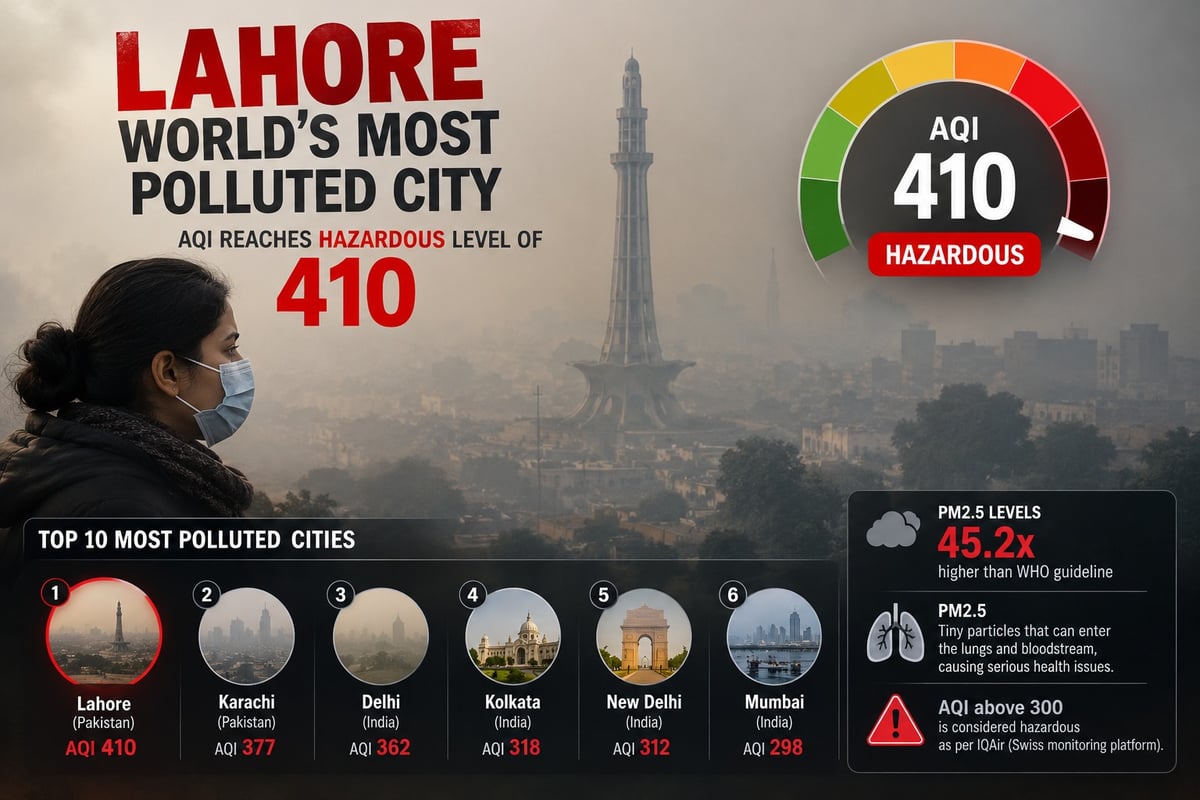
Lahore in Pakistan emerged as the world’s most polluted city on Friday, with the Air Quality Index (AQI) reaching a hazardous level of 410, according to an air quality monitoring platform.
The report also featured three Indian cities in the top 10. Kolkata, the capital of West Bengal, ranked fourth, followed by New Delhi in fifth place and Mumbai, the country’s financial capital, in sixth place.
According to the provincial government, Lahore and other parts of Pakistan’s Punjab province experience smog every year, particularly between October and February. In recent years, worsening air pollution has become a major public health and environmental concern across the province.
Health experts and air quality authorities have repeatedly urged residents to take precautions during periods of severe smog to reduce their exposure to harmful pollutants.
PM2.5 Levels 45.2 Times Higher Than WHO Annual Guideline
According to an IQAir report, the concentration of PM2.5 pollutants in Lahore was 45.2 times higher than the World Health Organization’s annual guideline.
PM2.5 refers to fine particulate matter measuring 2.5 micrometres or less in diameter. These tiny particles can penetrate deep into the lungs and may enter the bloodstream, potentially causing serious health problems, particularly with prolonged exposure.
AQI Above 300 Considered Hazardous
The Air Quality Index is a measure used to assess air pollution levels. A higher AQI value indicates poorer air quality and a greater potential risk to human health.
According to the Swiss air quality monitoring platform IQAir, an AQI reading above 300 falls into the hazardous category, indicating extremely poor air quality that can pose serious health risks.
The alarming reading in Lahore highlights the severity of the region’s seasonal smog problem and the growing concerns over the impact of air pollution on public health.