Punjab Newsline | Chandigarh
BY : Samriti Sharma
India’s battle against toxic air is becoming increasingly alarming, with millions of lives potentially at risk due to prolonged exposure to dangerous levels of air pollution. While deteriorating air quality continues to raise serious public health concerns across the country, a major international study has highlighted the devastating human cost of polluted air, bringing environmental monitoring and pollution-control measures under renewed scrutiny.
A study conducted by Sweden's Karolinska Institute has estimated that approximately 3.8 million (38 lakh) people died due to air pollution in India between 2009 and 2019. The findings underline the severe health consequences of long-term exposure to fine particulate matter, particularly PM2.5, when pollution levels remain above prescribed limits.
The research also raises concerns about the gap between India's national air-quality standards and the guidelines recommended by the World Health Organization (WHO). India currently prescribes an annual PM2.5 limit of 40 micrograms per cubic metre, while the WHO recommends a much stricter annual threshold of just 5 micrograms per cubic metre.
According to the study's estimates, assessing pollution-related deaths against the WHO-recommended threshold could push the number of fatalities to approximately 16.6 million (1.66 crore) during the same period. This would account for nearly 25 per cent of all deaths, suggesting that potentially one in every four deaths could be associated with air pollution under this assessment.
Why Is PM2.5 Particularly Dangerous?
PM2.5 refers to fine particulate matter measuring 2.5 micrometres or less in diameter. These microscopic particles pose a serious health risk because they can travel deep into the lungs and even enter the bloodstream, increasing the likelihood of severe health complications.
Their extremely small size makes them particularly dangerous. For comparison, most bacteria are at least 5 micrometres wide, a red blood cell measures around 6 micrometres, while the thickness of a human hair is approximately 70 micrometres. PM2.5 particles are therefore small enough to penetrate deep into the human respiratory system.
Punjab Turns to Drones to Track Stubble Burning
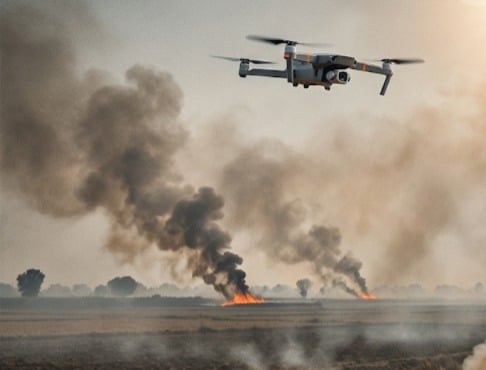
Amid growing concerns over air pollution and the need for more effective monitoring of pollution sources, the Punjab administration has decided to deploy drones in eight identified hotspot districts to strengthen surveillance against stubble burning.
The initiative aims to address potential gaps in satellite-based monitoring, particularly during evening hours when certain farm-fire incidents may go undetected. Drone surveillance will be conducted between 3 pm and 6 pm to improve the identification of stubble-burning incidents.
The move is expected to strengthen ground-level monitoring, help authorities detect farm fires more effectively and improve the accuracy of official records related to crop-residue burning.
Stronger Monitoring Needed to Tackle Pollution
The findings of the Karolinska Institute study highlight the urgent need for stronger and more comprehensive measures to tackle India's worsening air-quality crisis. While stubble burning remains an important seasonal concern, experts have repeatedly highlighted the need to address multiple pollution sources, including vehicular emissions, industrial activities, construction dust and other forms of fuel combustion.
Punjab's decision to introduce drone-based surveillance is aimed at improving the monitoring of farm fires. However, the wider challenge of reducing exposure to toxic air requires sustained action, reliable pollution data and stricter enforcement of environmental regulations.
With millions of lives potentially affected by prolonged exposure to polluted air, the study serves as a stark reminder that clean air is not merely an environmental concern but a critical public health necessity.