Punjab Newsline | Chandigarh
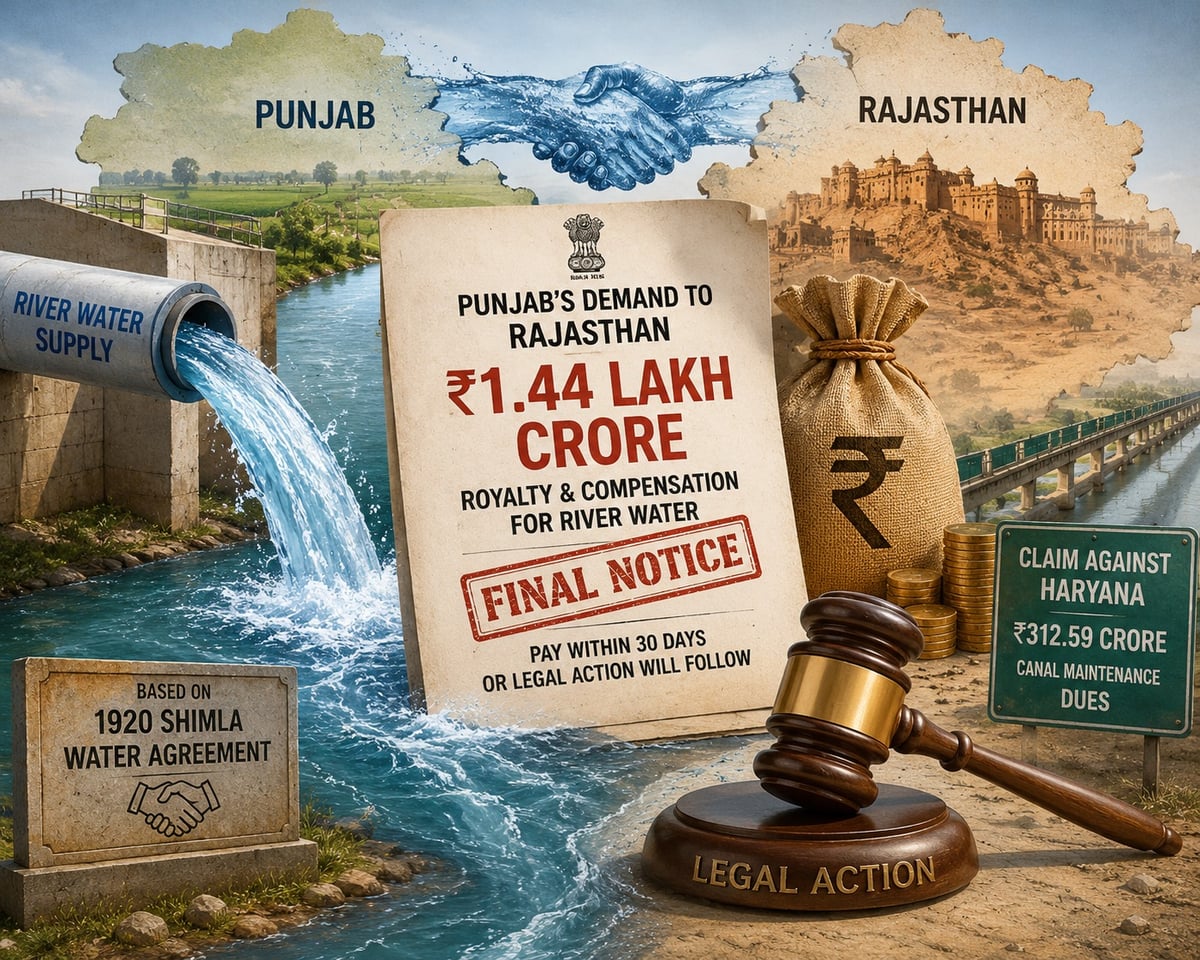
Punjab government has demanded ₹1.44 lakh crore from Rajasthan as royalty and compensation for river water supplied from Punjab, issuing a final demand notice and asking the state to deposit the amount within 30 days.
Punjab has warned that legal proceedings will be initiated if the payment is not made within the stipulated period.
According to Punjab, the claim relates to royalty on river water used by Rajasthan between 1961 and 2025. In a letter sent to the Additional Chief Secretary, Water Resources Department, Rajasthan, the Punjab government said that despite earlier correspondence, the outstanding amount has not been paid.
Punjab had previously written to Rajasthan on March 18 and May 4, but no settlement was reached.
The Punjab government has based its claim on a water-sharing agreement signed on September 4, 1920, in Shimla between the then rulers of Bikaner, Bahawalpur, and Punjab. According to Punjab, Bikaner used to pay a cess of ₹6.50 per acre per year for the water supplied.
Punjab has now recalculated the dues at the current rate of ₹141.20 per acre per year, including royalty on an average supply of 10 million acre-feet of water along with 8 percent interest. The state has also stated that Rajasthan continued paying royalty until the signing of the Indus Waters Treaty.
Meanwhile, Punjab has also raised a separate financial claim against Haryana. Punjab Chief Secretary K.A.P. Sinha has written to Haryana Chief Secretary Anurag Rastogi, seeking ₹312.59 crore towards the operation and maintenance of the shared carrier canals of the Bhakra canal system.
The demand includes ₹281.78 crore for the Bhakra Main Line Division, Patiala, and ₹30.80 crore for the Mansa Division. Punjab has alleged that Haryana has not paid its share of canal maintenance expenses since 2015–16.
The twin demands have brought inter-state water and canal-sharing financial disputes between Punjab, Rajasthan, and Haryana into sharp focus, with Punjab signalling a tougher stance on recovery of what it describes as long-pending dues.