Punjab Newsline | Islamabad
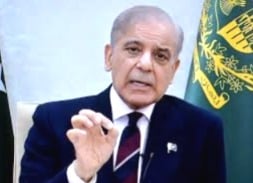
Pakistan Prime Minister Shehbaz Sharif has once again issued a strong warning to India over the water-sharing issue, declaring the Indus Waters Treaty a “red line” for Pakistan and urging New Delhi to reconsider its stance or face a “direct response.” Speaking at a programme held on the eve of Pakistan’s Independence Day, Sharif also accused India of being “an enemy of peace.”
The aggressive rhetoric comes at a time when Pakistan is grappling with multiple domestic challenges, including terrorist violence in Khyber Pakhtunkhwa, unrest in Balochistan, protests in Pakistan-occupied Jammu and Kashmir (PoJK), allegations of human rights violations, and the continued imprisonment of former Prime Minister Imran Khan.
India suspended treaty after Pahalgam terror attack
India suspended the Indus Waters Treaty after the 22 April 2025 terrorist attack in Pahalgam, Jammu and Kashmir, in which 26 people were killed. Following a meeting of the Cabinet Committee on Security (CCS) on 23 April, the Indian government decided to put the treaty on hold.
New Delhi has argued that the circumstances under which the agreement was originally signed have changed fundamentally. India has maintained that the treaty cannot continue in its existing form until Pakistan takes credible and concrete action against cross-border terrorism.
Pakistan calls India’s move ‘illegal’
According to the Prime Minister’s Office in Islamabad, Sharif said that India had unilaterally and illegally suspended the treaty, thereby proving itself to be “an enemy of peace.” He asserted that “every drop of Pakistan’s water is our red line” and insisted that there would be no compromise on the issue.
The Indus Waters Treaty, brokered by the World Bank in 1960, governs the sharing of water from the Indus river system between India and Pakistan and has long been considered one of the few enduring agreements between the two countries despite decades of tensions.
Internal dissent adds pressure on Islamabad
Even as Islamabad focused on warning India, it faced mounting criticism at home. In Balochistan, nationalist groups have called for 14 August to be observed as a “Black Day” instead of Pakistan’s Independence Day.
Baloch leader and activist Mir Yar Baloch appealed to Baloch communities around the world to boycott Independence Day celebrations. He urged supporters to wear black flags and black armbands as symbols of protest against what they describe as political repression and denial of rights.
Tensions remain high
Sharif’s latest remarks are expected to further strain already tense relations between India and Pakistan, particularly as both countries remain locked in a diplomatic standoff over terrorism, Kashmir, and the future of the Indus Waters Treaty. While Islamabad has adopted a confrontational tone, New Delhi continues to link any restoration of normal treaty arrangements to verifiable action against cross-border terror networks.