Punjab Newsline | New Delhi
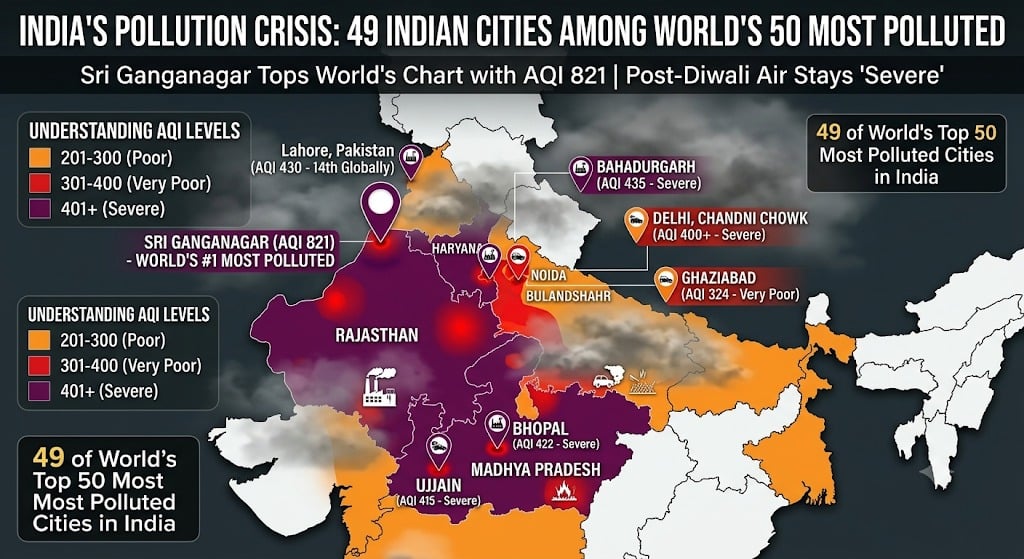
India continues to grapple with a severe air pollution crisis, with 49 of the world's 50 most polluted cities located in the country, according to data from AQI.in. Rajasthan's Sri Ganganagar topped the global pollution chart, recording an alarming Air Quality Index (AQI) of 821 at 9:54 am.
Pakistan's Lahore was the only city outside India to feature in the list, securing the 14th position with an AQI of 430.
Meanwhile, the impact of post-Diwali pollution continues to be felt across several states, with air quality remaining dangerously poor in many urban centres. In Delhi, Chandni Chowk recorded an AQI of over 400 at 6 am on Tuesday, while several other areas reported AQI levels above 300.
The situation was equally concerning in Madhya Pradesh and Haryana, where Bhopal, Ujjain and Bahadurgarh recorded AQI levels exceeding 400, placing them in the severe pollution category.
In Uttar Pradesh, Noida recorded an AQI of 332, followed by Bulandshahr at 331 and Ghaziabad at 324. These readings indicate very poor air quality across the three cities.
Alongside deteriorating air quality, temperatures have also started falling in parts of northern India. The night temperature in Madhya Pradesh dropped to 11 degrees Celsius, while parts of Uttar Pradesh recorded temperatures as low as 15 degrees Celsius.
Understanding AQI Levels
According to the Air Quality Index classification, an AQI between 201 and 300 indicates poor air quality, while readings between 301 and 400 fall under the very poor category. An AQI ranging from 401 to 500 is classified as severe.
Severe air pollution can affect even healthy individuals, while prolonged exposure may increase the risk of respiratory problems and other health complications.