Punjab Newsline | Chandigarh
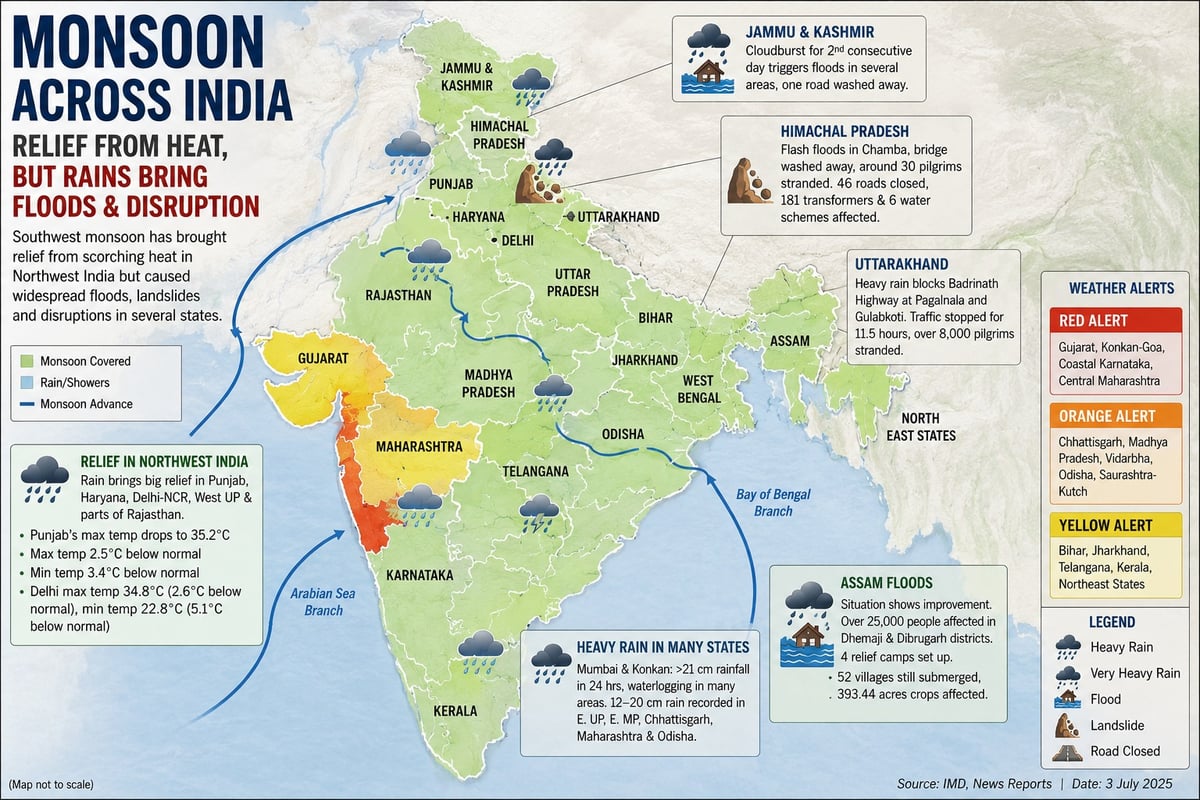
The southwest monsoon has finally brought much-needed relief from the prolonged heatwave across several parts of India, particularly Punjab, Haryana and the northwestern plains. However, the welcome rains have also unleashed widespread destruction, with flash floods, landslides and waterlogging affecting several states.
While intermittent showers significantly lowered temperatures in Punjab, Haryana, Delhi-NCR and parts of western Uttar Pradesh and Rajasthan, heavy rainfall triggered floods and infrastructure damage in Jammu & Kashmir, Himachal Pradesh and Uttarakhand.
According to the India Meteorological Department (IMD), maximum temperatures across Punjab and Haryana remained well below normal following widespread rainfall. Punjab recorded a sharp drop in temperatures, with the highest maximum temperature of 35.2°C reported in Rupnagar. The state's maximum temperature remained 2.5°C below normal, while minimum temperatures were 3.4°C below average.
The monsoon has now covered the entire Delhi-NCR region along with the remaining parts of Uttar Pradesh, Punjab, Haryana and most of Madhya Pradesh. Delhi witnessed light to moderate rainfall throughout Thursday, bringing relief from intense heat and humidity. The national capital recorded a maximum temperature of 34.8°C, 2.6 degrees below normal, while the minimum settled at 22.8°C, 5.1 degrees below average.
The IMD has forecast thunderstorms and rainfall across Delhi-NCR over the next three days, accompanied by strong winds of 50-70 kmph. Isolated areas could experience gusts reaching 80-100 kmph.
Elsewhere, Mumbai and the Konkan region received over 21 cm of rainfall in the past 24 hours, leading to waterlogging in several parts of the city. Heavy rainfall ranging between 12 cm and 20 cm was also recorded in eastern Uttar Pradesh, eastern Madhya Pradesh, Chhattisgarh, central Maharashtra and Odisha.
The weather department has issued red and orange alerts for Gujarat, Konkan-Goa, coastal Karnataka and central Maharashtra, warning of extremely heavy rainfall exceeding 204.5 mm at isolated locations. Orange alerts have also been issued for Chhattisgarh, Madhya Pradesh, Vidarbha, Odisha and Saurashtra-Kutch, while Bihar, Jharkhand, Telangana, Kerala and several northeastern states remain under yellow alert.
In Jammu & Kashmir, a second consecutive day of cloudbursts triggered flash floods in several areas, washing away a road and disrupting normal life.
Heavy rainfall continued to wreak havoc in Himachal Pradesh, where flash floods and landslides have severely impacted infrastructure. In Chamba district's Bharmour subdivision, a temporary wooden bridge near a temple was washed away following a sudden flash flood, leaving around 30 pilgrims stranded.
The Shimla Meteorological Centre has issued an orange alert for heavy to very heavy rainfall across parts of Himachal Pradesh from July 2 to July 5, excluding July 3. The state currently has 46 roads closed due to landslides, while 181 electricity transformers and six water supply schemes have also been affected.
In Uttarakhand, heavy rainfall led to major disruptions on the Badrinath Highway after massive debris blocked the road at Pagalnala and Gulabkoti. Vehicular movement remained suspended for nearly 11-and-a-half hours, leaving over 8,000 pilgrims stranded before traffic resumed late in the evening.
Meanwhile, Assam has witnessed some improvement in its flood situation. According to the Assam State Disaster Management Authority, the number of affected people has declined to just over 25,000 across Dhemaji and Dibrugarh districts, down from more than 48,000 a day earlier. Authorities have established four relief camps, while over 52 villages remain submerged and nearly 393.44 acres of cropland continue to be under floodwaters.