Punjab Newsline | Chandigarh
Ludhiana has emerged as Punjab’s strongest employment hub, recording better workforce participation and lower unemployment than several major Indian cities, including Delhi and Faridabad, according to the latest report by the Ministry of Statistics and Program Implementation covering cities with populations above one million.
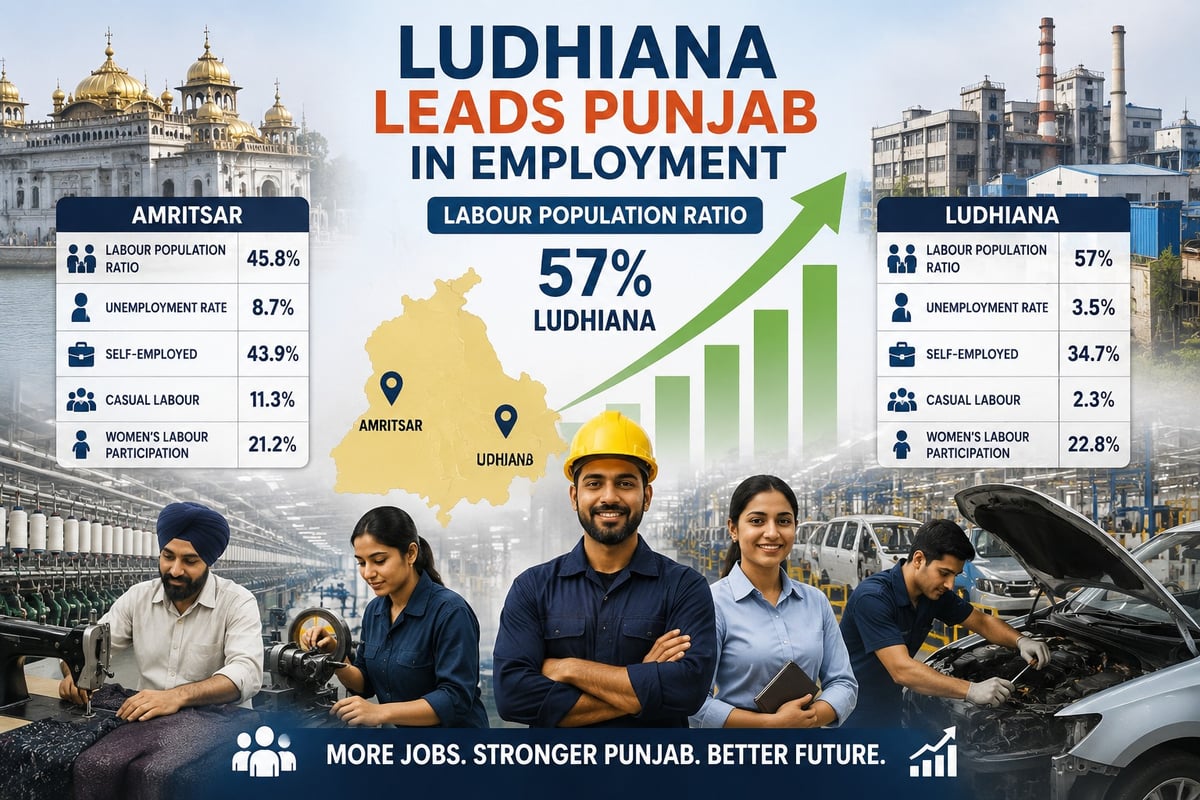
The report shows that Ludhiana’s Worker Population Ratio (WPR) stands at 57 per cent, significantly higher than Delhi’s 41.2 per cent and Faridabad’s 44 per cent. The city also reported that 63 per cent of its workforce is in regular salaried employment, matching or surpassing many other large urban centres.
The strong employment performance has been attributed to Ludhiana’s thriving industrial base. Growing activity in the manufacturing, automobile, and textile sectors has created sustained demand for skilled workers. To address this need, Industrial Training Institutes (ITIs) are introducing new skill-oriented courses aligned with industry requirements.
According to the report, 34.7 per cent of Ludhiana’s workforce is self-employed, while only 2.3 per cent are engaged as casual labourers. The city’s unemployment rate stands at 3.5 per cent, lower than Faridabad (4.9 per cent) and Delhi (5.3 per cent).
Despite the positive employment trends, female workforce participation remains a concern. Women’s Worker Population Ratio in Ludhiana is only 22.8 per cent. The unemployment rate among women is 3.8 per cent, slightly higher than 3.4 per cent for men. In comparison, Delhi recorded a female unemployment rate of 8.4 per cent, while the male unemployment rate stood at 4.7 per cent.
The report also highlights that Amritsar continues to lag behind Ludhiana in employment indicators. The city’s Worker Population Ratio is 45.8 per cent, with 69 per cent for men and just 21.2 per cent for women. Although the government has been making efforts to boost employment in the border district, the desired results have yet to materialise.
Amritsar’s overall unemployment rate has been recorded at 8.7 per cent, substantially higher than Ludhiana’s. The unemployment rate is 7.6 per cent for men and 12.3 per cent for women. The report notes that 43.9 per cent of the city’s workforce is self-employed, including 49.2 per cent of men and 25.9 per cent of women, while 11.3 per cent are employed as casual labourers.
The findings indicate that while women’s participation in the workforce has improved in both cities, it remains well below desirable levels, highlighting the need for continued policy support to promote inclusive employment growth across Punjab.