Punjab Newsline | Chandigarh
Punjab government has approved major amendments to its Land Pooling Policy, aiming to address landowners' concerns and ensure better compensation for farmers during land acquisition.
The decision was taken at a Punjab Cabinet meeting chaired by Chief Minister Bhagwant Singh Mann. The revised policy introduces enhanced residential and commercial plot allocations, along with several additional relief measures for affected landowners.
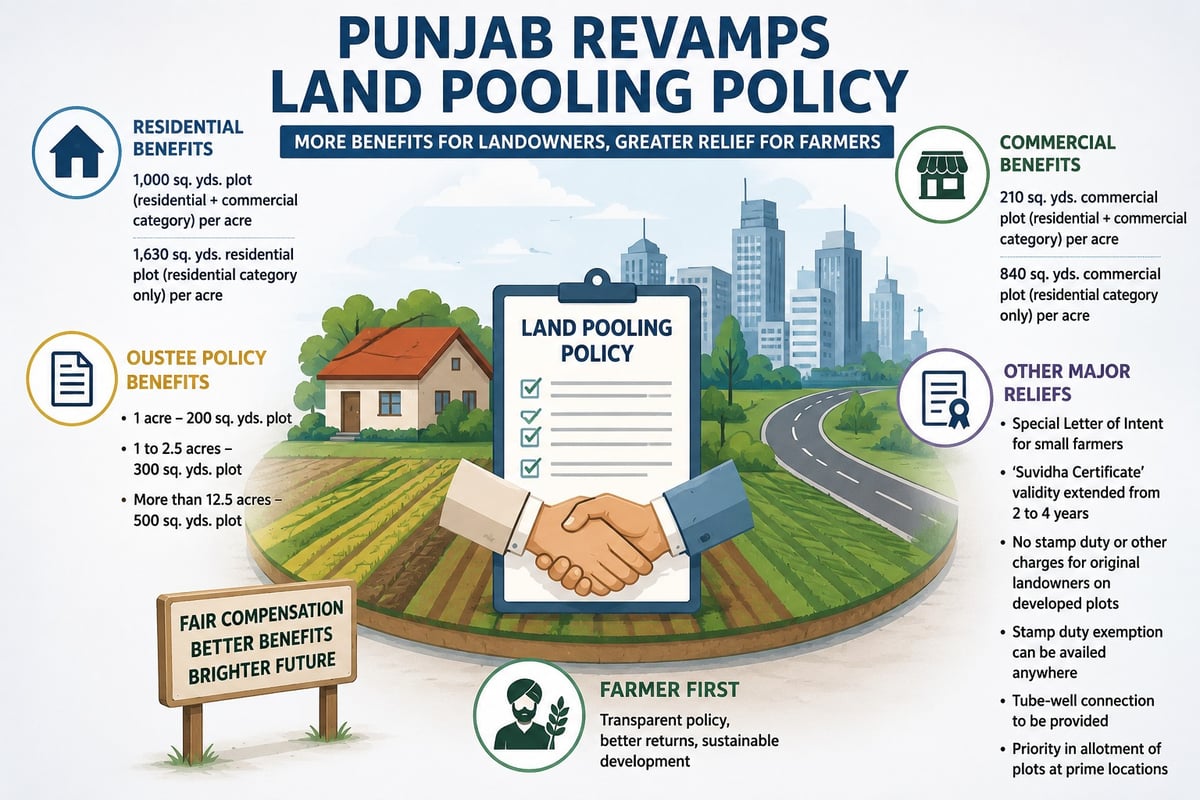
Under the amended Land Pooling Policy, landowners opting for both residential and commercial categories will continue to receive 1,000 square yards of residential plots per acre. However, the commercial plot allocation has been increased from 200 square yards to 210 square yards per acre.
For those choosing only the residential category, the residential plot entitlement has been increased from 1,600 square yards to 1,630 square yards per acre, while the commercial component has been raised from 800 square yards to 840 square yards per acre.
The Cabinet also approved changes to the OUSTEE Policy. Landowners whose one acre of land is acquired will now be entitled to a 200-square-yard residential plot. Those losing between one and 2.5 acres will receive a 300-square-yard plot, while landowners whose acquired land exceeds 12.5 acres will be eligible for a 500-square-yard plot.
To further support farmers, the government has introduced a special Letter of Intent (LOI) mechanism for small farmers. The validity of the 'Suvidha Certificate' has been extended from two years to four years.
Additionally, original landowners opting for developed plots will be exempt from paying stamp duty and other related charges. They will also be allowed to avail stamp duty exemption at any eligible location. The revised policy further provides tube-well connections and ensures that farmers will receive priority in the allotment of plots at preferred locations.
The Punjab government said the amendments are intended to make the land acquisition process more transparent, farmer-friendly, and beneficial for landowners while encouraging planned urban development across the state.