Punjab Newsline, New Delhi-
Former Delhi Chief Minister Arvind Kejriwal and former Deputy Chief Minister Manish Sisodia were on Friday discharged in the Delhi excise policy case, with a Delhi court delivering a sharp rebuke to the CBI and ruling that the prosecution had failed to substantiate its allegations with credible evidence.
The court held that claims of a larger conspiracy and criminal intent did not stand up to judicial scrutiny, as it discharged all 23 accused in the case, including former BRS leader K Kavitha.
The Aam Admi Party (AAP) leader was arrested in March 2024, weeks before India's general election, in connection with a liquor policy which authorities alleged gave undue advantages to private retailers.
On Friday, the court cleared Kejriwal and 23 others, saying there was "no overarching conspiracy or criminal intent in the excise policy".The judge also criticised the Central Bureau of Investigation (CBI) for a shoddy probe and recommended an inquiry against its officials. The CBI said they would appeal against the verdict.
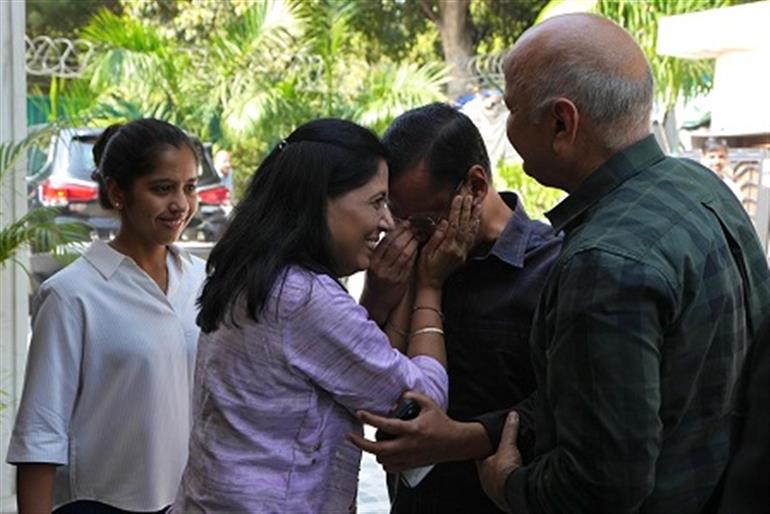
Following Friday's order, Kejriwal broke down outside the court while talking to journalists as former deputy chief minister Manish Sisodia hugged him. "In the end, unrighteousness and injustice are defeated and truth alone prevails," Kejriwal said.
Sisodia and AAP spokesperson Sanjay Singh were also arrested in the case in 2023 and are among the 23 cleared by the court. After their arrest, all three AAP leaders spent significant time in jail as they were repeatedly denied bail by the trial court and Delhi High Court before receiving relief from the Supreme Court.
Kejriwal had accused the governing BJP, which controls the police and investigating agencies in the capital, of plotting against him and targeting opposition leaders - allegations the BJP has denied. On Friday, the Rouse Avenue court in Delhi criticised the CBI for "trying to construct a narrative of conspiracy on the basis of mere conjecture", legal news website Bar and Bench reported. The court also rebuked the CBI for building its case on statements made by approvers - accomplices who turn state's witnesses in exchange for a pardon or reduced sentences.
"If such conduct is allowed, it would be a grave violation of the Constitutional principles... A fair investigation is essential for a fair trial," the court said. It added that it would recommend a departmental inquiry against CBI officials for their shoddy probe in the case.
The liquor policy which led to the arrests of AAP leaders was introduced by the Kejriwal government in 2021, saying it would curb black market sales, increase revenues and ensure even distribution of liquor licences.