Punjab Newsline | Chandigarh
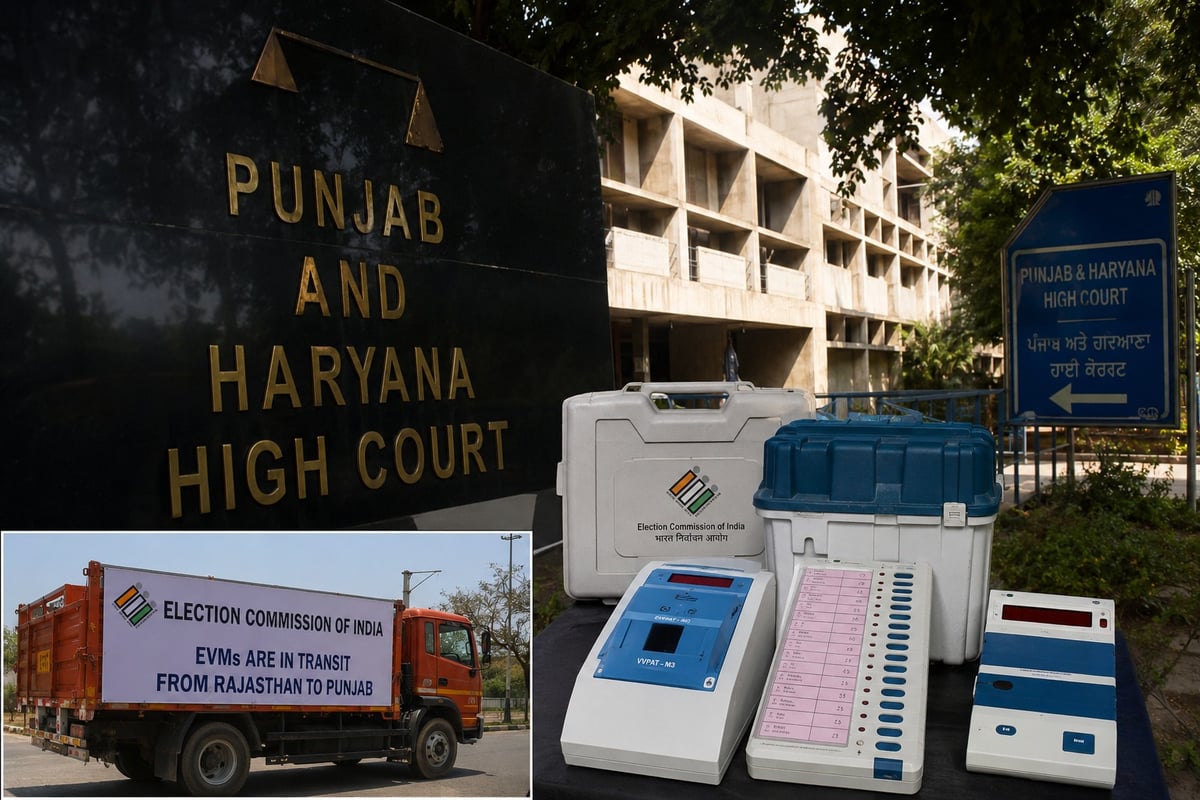
Just five days before Punjab’s municipal elections, the controversy over conducting polls through Electronic Voting Machines (EVMs) versus ballot papers has intensified. During a hearing in the Punjab and Haryana High Court on Thursday, the Election Commission of India (ECI) stated that the required EVMs had already been dispatched from Rajasthan to Punjab and that all technical preparations could be completed within a single day.
The matter was heard before a division bench led by Chief Justice Sheel Nagu. Representing the ECI, counsel informed the court that concerns regarding the availability of machines had been resolved following a letter sent to the Punjab State Election Commission on May 20.
The ECI told the court that Rajasthan was directly dispatching the machines to Punjab after the state allegedly expressed reluctance to collect them on its own. “The machines are on the way and currently in transit,” the commission’s lawyer submitted during the hearing.
The commission further clarified that arrangements were also being made to transport the machines to Mohali. It added that only the final delivery point and the authorized receiving officer were yet to be finalized.
Technical Process Can Be Finished in One Day: ECI
The ECI argued that the commissioning process and other technical procedures related to the EVMs could be completed within just one day. The commission also assured the court of full cooperation in first-level checking and commissioning of the machines.
The claim is significant because the Punjab State Election Commission had earlier informed the court that even if EVMs became available, their testing, preparation, and deployment would require 15 to 18 days. On that basis, the state commission had decided to conduct the May 27 local body elections using ballot papers.
Petition Challenges Ballot Paper Decision
The case pertains to a petition challenging the Punjab State Election Commission’s decision to hold municipal corporation, municipal council, and nagar panchayat elections through ballot papers instead of EVMs.
A day earlier, the ECI had presented a detailed timeline before the court, claiming that the delay occurred on the part of the state election commission and not the central poll body. Following this, the High Court directed the Punjab State Election Commission to file an affidavit clarifying its stand.
During the hearing, Punjab government’s chief counsel Maninderjit Singh Bedi questioned the maintainability of the petition itself, arguing that judicial intervention becomes limited once the election notification has been issued. Citing Supreme Court judgments, he urged the court to carefully examine the scope of the plea.